Reasoning Is the New Build Artifact
The cheapest AI workflow is not always the one that uses cheaper models everywhere. It is the one that turns expensive reasoning into a durable artifact, then lets lower-cost models execute against it.
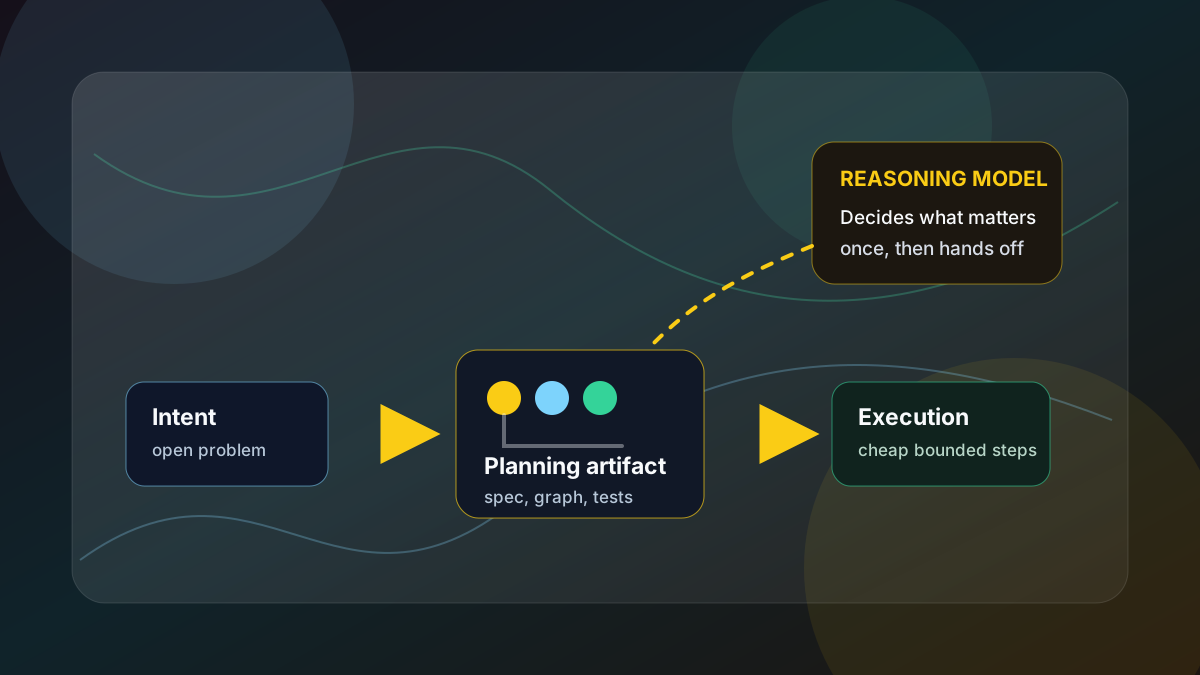
The simplest way to make AI workflows cheaper is not to make every model cheaper.
It is to stop using your most expensive model for every part of the job.
Use the strongest reasoning model to decide what should happen. Then use a cheaper, faster model to do the bulk of the execution.
That sounds like a small optimization. It is not. It is an architectural pattern.
The old pattern looks like this:
User request
  ↓
One expensive model thinks, plans, writes, edits, calls tools, fixes errors, and summarizes
  ↓
Final answer
The better pattern looks like this:
User request
  ↓
Frontier reasoning model
  ↓
Planning artifact
  ↓
Lower-cost execution model or models
  ↓
Tests, review, and occasional re-planning
  ↓
Final output
The key phrase is planning artifact.
Not a vibe. Not a transcript of hidden chain-of-thought. Not a vague outline.
A planning artifact is a concrete object: a spec, task graph, implementation plan, dependency map, checklist, test plan, or structured JSON plan that another model can execute without rediscovering the strategy from scratch.
The expensive model does the hard part once.
The cheaper model spends the tokens.
The expensive part is not the typing
A lot of AI usage still treats the model as a monolithic worker: give it a problem, let it think, let it act, let it continue, let it revise, let it recover from mistakes.
That is convenient, but it is also wasteful.
In many workflows, the expensive part is not writing the tenth function, formatting the third table, extracting the fifth field, or calling the seventh tool. The expensive part is deciding:
- what the actual problem is;
- which constraints matter;
- what can be done in parallel;
- what order the work should happen in;
- where the failure modes are;
- what "done" should mean.
That is planning. Planning is reasoning-heavy. Execution is often not.
Once the plan exists, most of the remaining work becomes narrower. A cheaper model does not need to solve the whole problem. It only needs to execute a bounded instruction:
Implement step 4.
Use the interface defined in step 2.
Do not change the schema.
Return only the patch and the test result.
That is a very different task from:
Figure out this whole project and build it.The first task is execution. The second task is open-ended reasoning.
They should not always be priced the same.
Planning is becoming compilable
The best analogy is not "manager and intern."
The better analogy is compiler and runtime.
A compiler spends effort up front. It analyzes the program, checks constraints, optimizes the structure, and emits something executable.
A good AI planner should do the same.
Intent
  ↓
Reasoning model
  ↓
Plan, spec, or task graph
  ↓
Execution models plus tools
  ↓
Validated result
In this framing, the plan is an intermediate representation. It is not merely advice. It is the thing that makes cheap execution possible.
A strong planning artifact should include:
- Objective: what are we trying to accomplish?
- Constraints: what must not change, and what budget, latency, policy, design, or compatibility limits matter?
- Assumptions: what is the model assuming that should be checked?
- Task graph: what steps are required, and which steps depend on which other steps?
- Execution instructions: what should each executor do, and what context does it need?
- Acceptance criteria: how do we know the work is correct?
- Validation plan: what tests, reviews, or checks should run before completion?
- Re-planning triggers: when should the executor stop and ask the planner to revise the plan?
That artifact can be cached, inspected, versioned, edited by a human, passed to multiple models, or reused later.
That is the deeper point:
Reasoning becomes reusable once it becomes an artifact.
This idea is older than reasoning models
The current version of this pattern feels new because modern reasoning models make the economics obvious. But the intellectual lineage goes back several years.
The earliest useful root is the idea that language models can act as planners. In January 2022, Language Models as Zero-Shot Planners showed that sufficiently large pretrained language models could decompose high-level tasks into mid-level action plans without additional training.
A few days later, Chain-of-Thought Prompting Elicits Reasoning in Large Language Models showed that intermediate reasoning steps could improve performance on complex reasoning tasks. That paper was not about cost. It was about capability. But it made a crucial idea mainstream: the intermediate reasoning process has value.
Then came agent loops.
ReAct, introduced in 2022, combined reasoning traces with actions, letting a model alternate between thinking and doing. This was powerful, but it had an economic problem: every step often called the same capable model again.
By 2023, systems began separating the roles more explicitly. HuggingGPT used ChatGPT as a controller to plan tasks, select specialist models, execute subtasks through those models, and summarize the result. BabyAGI popularized a task loop with execution, task creation, and prioritization agents.
Then LangChain gave the pattern a clear name: Plan-and-Execute. In May 2023, LangChain described agents that first plan steps and then execute them, explicitly separating higher-level planning from shorter-term execution.
The cost angle became clearer in 2024. LangChain's later Plan-and-Execute writeup stated that the pattern can save cost because sub-tasks can be handled by smaller or domain-specific models, while the larger model only handles planning, re-planning, and final response generation.
So the origin is layered:
2022: language models can plan
2022: intermediate reasoning improves results
2022: reasoning plus acting loops emerge
2023: planner and executor agents become common
2023: model cascades formalize cost-aware model selection
2024: plan-and-execute becomes a cost-saving agent pattern
2024+: reasoning models make the split economically obvious
The new part is not planning.
The new part is treating the plan as a durable artifact that lets cheaper models execute most of the work.
Why reasoning models make this pattern more important
Reasoning models changed the cost equation because they spend extra compute on thinking before answering. OpenAI's o1 launch described the model family as designed to spend more time thinking before responding and to reason through harder problems in science, coding, and math.
OpenAI's API documentation also describes reasoning models as using reasoning tokens in addition to input and output tokens. Those reasoning tokens are used internally to break down prompts and consider approaches; they are not visible through the API, but they still occupy context and are billed as output tokens.
That means a reasoning model is not just another text model. It is a model that may spend a lot of budget on internal deliberation.
That is good when the task needs deliberation.
It is wasteful when the task only needs execution.
A practical rule emerges:
Use reasoning models where mistakes are expensive. Use cheaper models where instructions are clear.
The cost-saving architecture
A production version of this pattern usually has four roles.
1. Planner
   A frontier reasoning model creates the plan.

2. Artifact
   The plan is saved as Markdown, JSON, YAML, tickets, or a task graph.

3. Executor
   One or more cheaper models execute narrow steps.

4. Reviewer
   Tests, deterministic checks, or a stronger model validate the result.
For software development, that might look like this:
Reasoning model:
  "Design the migration plan. Identify risky files. Define acceptance tests."

Planning artifact:
  implementation_plan.md

Cheaper coding model:
  "Execute task 3 only. Do not modify public interfaces."

Automated checks:
  unit tests, type checks, linting

Reasoning model again:
  "Review failures and revise the plan only if needed."
For research, it might look like this:
Reasoning model:
  "Create the research strategy and source-quality criteria."

Cheaper model:
  "Collect sources matching section 2. Extract only title, author, date, and claim."

Reasoning model:
  "Synthesize the evidence and identify gaps."
For writing, it might look like this:
Reasoning model:
  "Create the thesis, structure, counterarguments, and evidence map."

Cheaper model:
  "Draft section 3 using only the approved outline and references."

Reasoning model:
  "Edit for logic, omissions, and unsupported claims."
The planner is not doing less important work. It is doing more important work, less often.
The plan should constrain the executor
The executor model should not be asked to be creative unless creativity is required.
A weak planning artifact says:
Write the feature.A strong planning artifact says:
Task 4: Add server-side validation for the checkout form.

Inputs:
- Existing schema: CheckoutFormSchema
- File: src/checkout/validation.ts
- Do not modify the payment provider interface.

Steps:
1. Add validation for missing postal code.
2. Add validation for unsupported country codes.
3. Return typed validation errors.
4. Add unit tests for both cases.

Acceptance criteria:
- Existing tests pass.
- New tests fail before the change and pass after.
- No public API changes.
The second version is cheaper to execute because it removes ambiguity.
Ambiguity is where cheaper models burn tokens.
Ambiguity is also where they make mistakes.
The pattern is not always cheaper
This architecture is not magic. It saves money when the planning artifact prevents repeated expensive reasoning.
It can cost more when:
- the task is tiny;
- the planner over-decomposes the work;
- the executor is too weak and causes repeated retries;
- the plan is vague;
- the validation loop calls the frontier model too often;
- the artifact is longer than the task deserves.
This is why the plan must be economical.
The planner should not produce a novel. It should produce the minimum artifact that makes execution reliable.
A useful budget rule:
Use the expensive model to reduce uncertainty.
Do not use it to generate bulk text.
What this changes
This pattern changes how AI systems should be designed.
Instead of asking, "Which model should do this task?" ask:
Which part of this task requires reasoning?
Which part only requires execution?
What artifact can transfer the reasoning from one to the other?
That question leads to better systems.
It leads to AI workflows that are:
- cheaper, because fewer tokens hit the frontier model;
- faster, because execution steps can be parallelized;
- safer, because the plan can be reviewed before execution;
- more reliable, because each executor gets a narrower job;
- more auditable, because the plan survives after the model call ends.
The plan becomes a contract.
The executor follows the contract.
The reviewer checks the contract.
That is much closer to engineering than prompting.
The future: reasoning caches
The next step is not just planner and executor systems.
The next step is reasoning caches.
If a reasoning model creates a high-quality plan for migrating a codebase, designing a test suite, researching a market, or writing a policy document, that artifact should not disappear after one run.
It should be saved.
It should be reused.
It should be diffed.
It should become part of the project.
Imagine a repository with this structure:
/docs
  product_spec.md
  architecture.md
  reasoning_artifacts/
    migration_plan_2026-07-09.md
    test_strategy.md
    risk_register.md

/tasks
  executor_step_001.md
  executor_step_002.md
  executor_step_003.md
Now the AI system is not just chatting. It is producing durable project infrastructure.
That is the real shift.
Conclusion
The winning AI workflow is not:
Use the biggest model for everything.It is:
Use the best reasoning model to create the plan.
Use cheaper models to execute the plan.
Use tests and selective review to keep the system honest.
The frontier model becomes the architect.
The cheaper model becomes the builder.
The plan becomes the interface between them.
That interface is where the leverage is.
The more expensive reasoning gets, the more valuable this pattern becomes. Not because reasoning matters less, but because it matters more.
You do not want to waste reasoning.
You want to compile it.
References
- Wenlong Huang, Pieter Abbeel, Deepak Pathak, and Igor Mordatch, Language Models as Zero-Shot Planners: Extracting Actionable Knowledge for Embodied Agents, submitted January 18, 2022. arXiv
- Jason Wei et al., Chain-of-Thought Prompting Elicits Reasoning in Large Language Models, submitted January 28, 2022. arXiv
- Shunyu Yao et al., ReAct: Synergizing Reasoning and Acting in Language Models, 2022. arXiv
- Yongliang Shen et al., HuggingGPT: Solving AI Tasks with ChatGPT and its Friends in Hugging Face, submitted March 30, 2023. arXiv
- Yohei Nakajima, "Birth of BabyAGI," April 1, 2023. Yohei Nakajima
- LangChain, "Plan-and-Execute Agents," May 10, 2023. LangChain
- LangChain, "Plan-and-Execute Agents," February 13, 2024. LangChain
- OpenAI, "Introducing OpenAI o1," September 12, 2024. OpenAI
- OpenAI API documentation, "Reasoning models." OpenAI Developers
- Lingjiao Chen, Matei Zaharia, and James Zou, FrugalGPT: How to Use Large Language Models While Reducing Cost and Improving Performance, submitted May 2023. arXiv
- Sehoon Kim et al., An LLM Compiler for Parallel Function Calling, submitted December 7, 2023 and later accepted to ICML 2024. arXiv